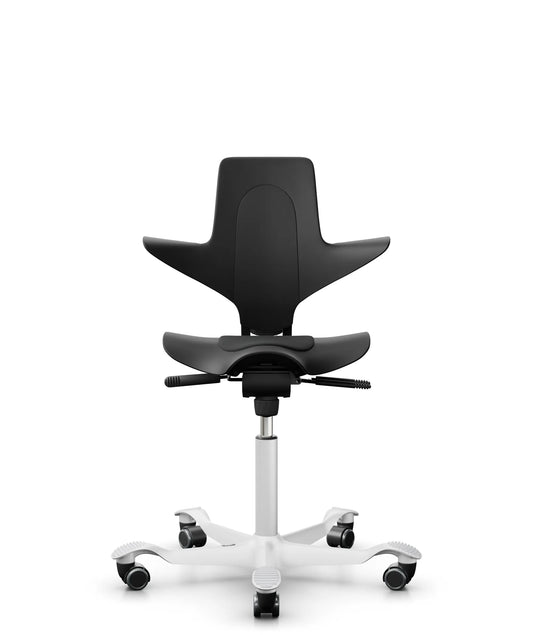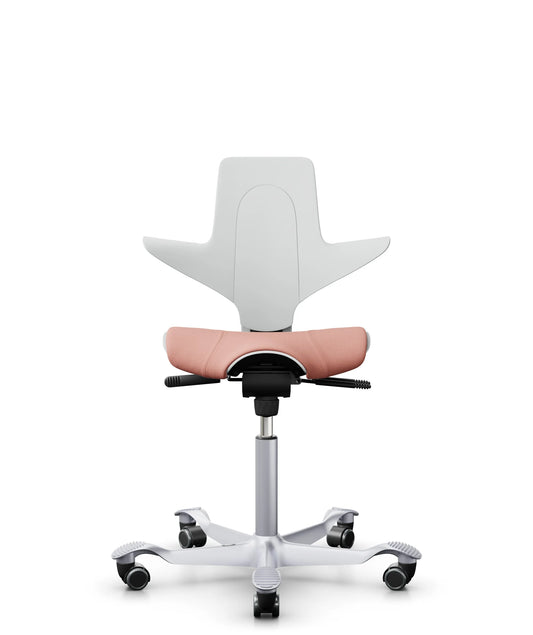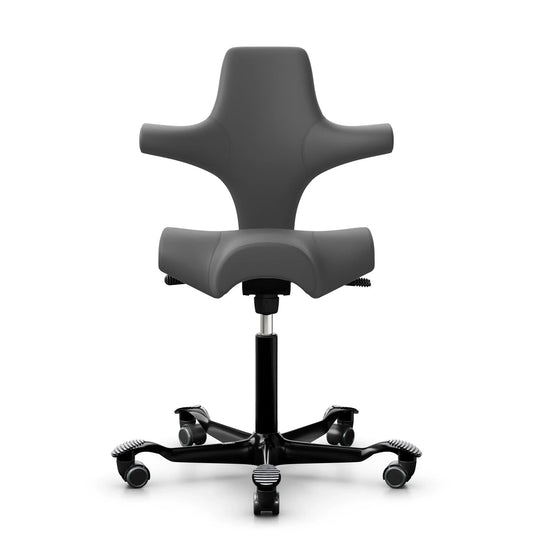

If you've spent any time down the ergonomic chair rabbit hole, you've probably come across the HAG Capisco — that odd-looking saddle-style chair that looks like it belongs in a stable, not a home office. It's polarizing. People either fall in love with it immediately or scroll past it thinking it's some kind of design student's fever dream.
But here's what the skeptics are missing: for people dealing with chronic back pain, the Capisco isn't just a quirky aesthetic choice. It's one of the most thoughtfully engineered seating solutions on the market. Let's break down exactly why.
The Problem With Most Chairs: They're Built for Passivity
Traditional office chairs are designed around one assumption — that you'll sit still, upright, with your feet flat on the floor. And for short periods, that works fine. But the human body was never meant to hold a single static position for hours at a time.
When you sit in a conventional chair for extended periods, a few things happen:
Your hip flexors shorten and tighten. Your lumbar spine loses its natural inward curve (lordosis) and begins to flex forward. The discs in your lower back take on uneven compressive loads. Blood flow to your legs and glutes slows. And the muscles meant to support your spine gradually switch off — because the chair is doing the work for them.
The result? That familiar ache that starts in the lower back, creeps up to the shoulders, and by 3pm has you shifting in your seat every five minutes.
What Makes the HAG Capisco Different
1. The Saddle Seat Design Restores Your Natural Spinal Curve
The most important feature of the Capisco is its saddle-shaped seat. Unlike a flat seat pan, the saddle tilts your pelvis forward slightly — mimicking the position you naturally adopt when you stand or walk.
Why does this matter for your back? When your pelvis tilts forward into what's called an "anterior tilt," your lumbar spine naturally reassumes its inward curve (lordosis). This is the spine's strongest, most mechanically efficient position. It distributes load evenly across the vertebral discs and takes pressure off the facet joints and surrounding soft tissue.
In plain terms: the Capisco nudges your spine into the position it actually wants to be in — the same position that often disappears after years of sitting in chairs that encourage slouching.
2. It Encourages Active Sitting
The Capisco isn't a chair you sink into. It's a chair you sit with. Because the saddle seat doesn't offer the same passive support as a deep bucket seat, your core muscles have to engage — just slightly, just enough — to keep you balanced.
This low-level muscle activation is actually a good thing for back pain sufferers. Gentle engagement of the spinal stabilizers (the multifidus, transverse abdominis, and erector spinae) keeps those muscles awake and working, rather than allowing them to atrophy from disuse. Think of it less like a workout and more like a gentle reminder to your body that it's still in the game.
3. You Can Sit Forward, Backward, or Sideways
Here's where the Capisco really earns its reputation. Thanks to its distinctive saddle seat and backrest design, you can sit on it in multiple orientations:
Forward-facing traditional: Back against the backrest, feet on the floor or footrest — conventional, but already more ergonomic than most chairs.
Saddle position: Straddling the seat with the narrow front of the saddle between your legs, much like sitting on a horse. This maximizes pelvic tilt and spinal extension, and is particularly useful for people who find sustained sitting painful but need to stay at their desk.
Reverse saddle: Facing backward, with your chest resting against the backrest. This dramatically reduces lumbar and cervical load and is excellent for people with disc issues who find forward-leaning tasks (like writing or using a mouse) aggravating.
The ability to vary your position throughout the day is one of the most underrated tools in managing chronic back pain. Movement — even the micro-movement of shifting between sitting orientations — reduces the cumulative load on spinal structures and keeps the supporting muscles active.
4. Height Adjustability That Goes Beyond the Norm
The Capisco is designed to work across an unusually wide height range — it can be set low enough for a standard desk and high enough for a standing-desk height perch. This makes it ideal for people using sit-stand desks, which is one of the most evidence-backed interventions for reducing sedentary-related back pain.
Rather than standing for prolonged periods (which brings its own set of problems), the Capisco lets you perch at standing-desk height — taking weight off your feet while maintaining the active, open hip angle you get from standing. It's genuinely the best of both worlds.
5. No Lumbar Support Required — Because You Don't Need It
Traditional chairs rely heavily on a lumbar support cushion or adjustment to prop the lower back into the correct curve. The Capisco takes a different approach: by getting the pelvis into the right position first, the lumbar curve follows naturally, without external propping.
This isn't just a design choice — it reflects a more fundamental understanding of how the spine works. Lumbar support in conventional chairs is often compensating for the problems created by the chair itself. The Capisco largely eliminates the root cause.
Who Benefits Most From the HAG Capisco?
The Capisco isn't the right chair for everyone. But certain profiles tend to see significant improvement:
People with lower back pain or disc issues — especially those who find prolonged sitting aggravates their symptoms. The saddle seat reduces disc compression and restores lordosis.
People with tight hip flexors — common in those who sit for long hours. The open hip angle of the saddle seat gently lengthens the hip flexors over time.
Tall individuals — the Capisco accommodates heights that most office chairs simply can't reach, and long-legged users often find conventional chairs force them into awkward knee and hip positions.
Sit-stand desk users — the perching height capability makes the Capisco a natural companion for height-adjustable desks.
People who fidget — if you find yourself constantly shifting, recrossing your legs, or repositioning, the Capisco's versatility will feel like a relief.
A Note on the Adjustment Period
It would be dishonest not to mention this: the Capisco has a learning curve. If you've spent years in a conventional chair, your body has adapted — often unhelpfully — to that position. The saddle seat can feel strange or even slightly uncomfortable for the first week or two as your hip flexors lengthen and your core muscles reactivate.
Most people find that this passes within two to three weeks with regular use. Some find it helpful to start with shorter sitting periods and build up gradually. The discomfort, when it occurs, is typically the sensation of muscles waking up and lengthening — not a sign that something is wrong.
If you have a specific injury or clinical condition, it's always worth checking with a physiotherapist before making a significant change to your seating setup.
The Bottom Line
The HAG Capisco doesn't look like a traditional ergonomic chair because it isn't one. It's a fundamentally different approach to seating — one that works with the body's mechanics rather than compensating for the problems created by conventional chair design.
For people dealing with back pain, that difference can be transformative. Not because it's a medical device, but because it encourages the body to return to the positions and movement patterns it was designed for.
If your current chair has you reaching for ibuprofen by mid-afternoon, it might be time to take the Capisco seriously — saddle shape and all.